


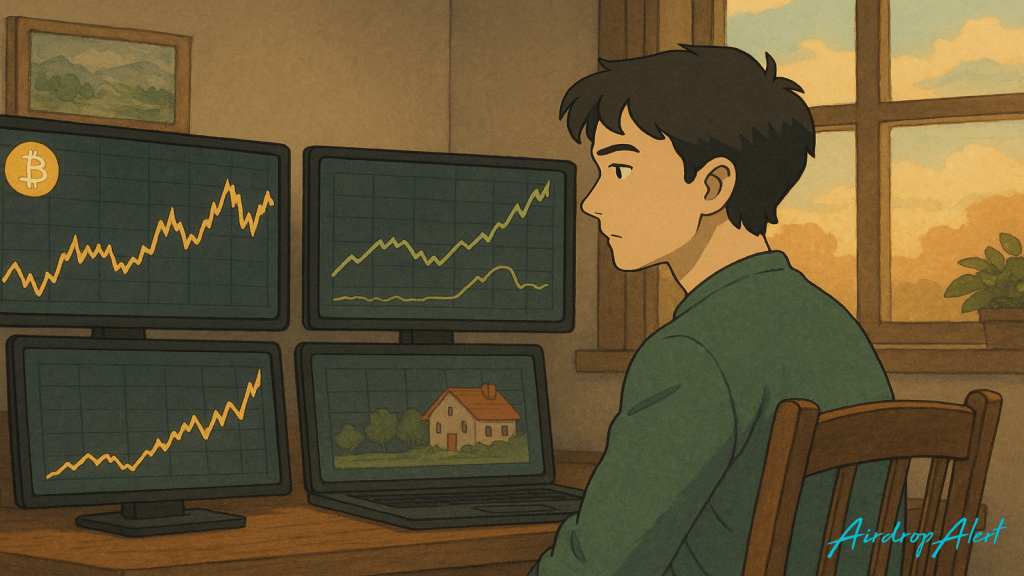
Every Bitcoin bull run used to follow a familiar pattern. A halving, a rally, a wild top, and then the painful crash. This time, something feels off. Bitcoin keeps making tiny new all-time highs, only to fall 10 percent and range for weeks. Then it creeps up again, breaks a few hundred dollars higher, and repeats the whole thing.
I’ve been trading and watching charts during my recent travels, and it’s the first cycle where I find myself checking the charts and thinking, “This just doesn’t feel like the others.” It’s not bad, but it’s weird. Let’s explore why.
The Strange Rhythm of This Cycle
Usually, when Bitcoin makes a new all-time high, momentum follows. You’d expect a decent pump, liquidations, and fireworks across social media. Instead, every breakout feels weak. It’s like watching someone trying to sprint through mud.
The pattern is consistent. A small new ATH, then a correction. Sideways action for weeks, sometimes months. Retail gets bored, volatility fades, and then—another slow crawl higher. It’s a slow-motion bull market.
So, what’s going on here? Is Bitcoin maturing, or is someone pulling strings behind the scenes?
Let’s explore a few theories.
Paper Bitcoin: The Invisible Supply
One of the most popular ideas floating around is the rise of “paper Bitcoin.” This term refers to synthetic exposure—ETFs, futures contracts, and custodial products that give investors Bitcoin exposure without requiring real coins on-chain.
With BlackRock’s IBIT, Fidelity’s FBTC, and a list of other ETFs trading daily, the question is whether every share truly represents a single Bitcoin in cold storage. Some analysts believe these instruments create “IOU Bitcoin,” where investors think they own BTC but are actually holding paper claims.
If that’s true, the supply dynamics are very different. Real Bitcoin on the blockchain becomes scarcer, while the synthetic market expands. Price action would feel muted because every new ETF dollar doesn’t always translate to a real coin being taken off the market.
This theory fits the current cycle well. We see inflows, but not the parabolic moves of previous years. There’s demand, but it feels absorbed by invisible layers of paper Bitcoin.
Institutional Market Control
This is also the first full Bitcoin cycle under institutional control. Back in 2017 or even 2021, the market was driven by retail traders and crypto natives. Now, it’s all about ETFs, liquidity desks, and market makers connected to Wall Street.
Firms like BlackRock, Citadel, and JPMorgan have deep derivatives exposure. They don’t trade on emotion. Their algorithms rebalance portfolios, control volatility, and manage flows in ways that often neutralize sharp moves.
These entities make money through stability and consistent fees, not chaotic rallies. If they can keep Bitcoin inside a predictable range, they attract more long-term investors and reduce the risk of regulatory panic. That could explain the slow, controlled growth.
Every new all-time high might be less about demand pressure and more about rebalancing the system to a higher equilibrium—an invisible hand keeping things “orderly.”
The Macro Chessboard
Another piece of this weird puzzle lies in the global economy. In 2025, macro conditions are unlike anything we’ve seen before. Inflation remains sticky, interest rates are still high, and central banks are trying to unwind years of aggressive money printing.
The U.S. Federal Reserve isn’t cutting as quickly as bulls hoped. China is stimulating, Europe is tightening, and the U.S. is stuck between politics and economics. The dollar remains strong, which usually limits upside in risk assets like crypto.
Bitcoin reacts to this environment in strange ways. It rallies on optimism, then stalls when yields rise or liquidity tightens. Global capital flows are fragmented, and risk appetite fluctuates every week. The result is exactly what we’re seeing—small rallies, frequent corrections, and no clear trend acceleration.
This isn’t just a crypto issue; it’s a macro liquidity issue. The money that usually drives wild rallies is moving slower.
Related: Did Trump & China crash the markets again?
Whale Distribution and ETF Front-Running
On-chain data tells another part of the story. Old whales—miners, early investors, and dormant addresses—have been slowly selling into strength. They don’t dump everything at once. Instead, they sell just enough to create constant overhead resistance.
At the same time, ETF issuers and institutions accumulate gradually. They front-run inflows, buy dips, and spread out purchases to avoid moving the market too fast. It creates an equilibrium where both sides are active, but neither wins decisively.
Every time price inches up, supply meets it. Every time price dips, institutions step in to buy. It’s like two massive players arm-wrestling in slow motion. Retail feels like nothing is happening, but under the surface, billions are shifting hands.
This kind of distribution-accumulation balance can keep markets range-bound for months. The longer it continues, the more explosive the eventual breakout becomes—but we might still be far from that moment.

Regulatory Uncertainty and Political Games
This cycle is also dominated by politics. The U.S. election, the ongoing global regulatory debates, and constant chatter about stablecoins, CBDCs, and crypto taxes create a fog of uncertainty.
For institutional investors, that fog means one thing: caution. If you’re a fund managing billions, you don’t want Bitcoin spiking 40 percent in a week while the SEC drafts new rules. You want stability.
Some speculate that big players intentionally keep Bitcoin “quiet.” It makes it easier to accumulate, easier to manage headlines, and less likely to attract unwanted political attention. If retail excitement stays low, Bitcoin can slowly integrate into traditional finance without triggering another 2017-style frenzy.
That’s not a crazy idea. It’s strategy.
The Psychology Shift in Retail
Retail behavior has changed a lot. The crypto crowd that used to FOMO into every pump is tired. After years of scams, liquidations, and fake narratives, enthusiasm has cooled.
Look at social media. In 2021, every 5 percent move trended on Twitter. In 2025, Bitcoin can make a new ATH, and half the community barely reacts. It’s not apathy—it’s fatigue.
Many retail traders now focus on airdrops, memes, or DeFi farming rather than chasing the main market. They prefer to grind points and multipliers than sit through boring price ranges. That shift in attention leaves Bitcoin with fewer emotional buyers.
Without the emotional energy of retail, Bitcoin’s rallies feel mechanical. Institutions provide the capital, but not the hype. And without hype, parabolas don’t form.

The Halving Effect Is Slower This Time
In past cycles, the halving acted as a spark. Supply dropped, demand stayed constant, and price exploded. But this time, the halving effect seems delayed.
Part of that is due to ETFs absorbing demand gradually. Another part is that miners were better prepared. Many hedged their production in advance or sold future hashrate. The supply shock is still happening—but at a pace that feels more like a slow burn than a firework.
We might be underestimating how slow this effect can be in a mature market. In 2012 or 2016, it took months to see results. In a trillion-dollar asset, it might take much longer for the reduced emission to show up in price.
Related: Is this the cycle top?
Global Liquidity Flows
Bitcoin now trades as part of the global financial system. It’s not an isolated digital coin anymore—it’s a macro asset tied to liquidity cycles.
When global liquidity expands, Bitcoin benefits. When it contracts, it stalls. The issue is that liquidity isn’t uniform. The U.S. might be draining, while Asia is easing. That mismatch creates chop.
Some traders believe Bitcoin’s price action mirrors global M2 money supply with a delay. If that’s true, the weird, sideways behavior we’re seeing might be the reflection of uneven liquidity around the world.
Until those cycles sync up, Bitcoin might keep grinding instead of exploding.
Maybe It’s Just Growing Up
There’s also a simpler explanation. Maybe Bitcoin isn’t weird—it’s just growing up.
When you reach trillion-dollar market cap territory, every 10 percent move requires tens of billions in inflows. The law of large numbers kicks in. Volatility drops, and the wild rides of early cycles fade away.
That doesn’t mean Bitcoin is broken. It means it’s maturing. The small new highs, the slower rallies, the range trading—it might all be a sign of stability, not weakness.
For long-term holders, that’s a good thing. A mature Bitcoin can attract pensions, sovereign funds, and larger capital pools that prefer stability over chaos. It’s just not as exciting for traders looking for the next big breakout.
The Manipulation Theory
Of course, there’s always the darker explanation. Some traders are convinced that big institutions intentionally suppress Bitcoin’s price. Through derivatives, over-the-counter trades, and coordinated liquidity walls, they can cap upside while accumulating at lower levels.
This idea ties back to paper Bitcoin. If enough players can control the supply flow through synthetic exposure, they can dampen volatility and buy time to build bigger positions. It’s not illegal—just strategic.
Whether it’s manipulation or sophisticated risk management, the effect is the same. The market feels controlled, predictable, and sometimes lifeless. Until it doesn’t.
A Market Waiting for Its Moment
The weirdness might simply be a build-up phase. Every boring range, every fake breakout, every slow pullback—it all adds pressure. When that pressure releases, it usually does so violently.
The next parabolic leg could be forming beneath our feet. We just don’t see it yet because this cycle has changed its rhythm. It’s quieter, more calculated, and more connected to macro and institutional forces than ever before.
My Take While Traveling
I’ve been traveling lately, catching flights, weddings, and family trips, but even from the other side of the world I keep glancing at charts. The setups look healthy but confusing. Bitcoin feels strong, yet hesitant. The dips get bought, but the highs fade quickly.
It’s like watching two forces battle in silence—old crypto versus the new Wall Street version. Somewhere between those two worlds, the real price discovery is happening.
And maybe that’s the point. Bitcoin is no longer just a rebellion against the system. It’s slowly becoming part of it.
My Personal Decision After 12 Years in Bitcoin
I’ve been in Bitcoin since 2013. I’ve seen it rise from a wild idea to a global financial force. I’ve always been a believer in decentralized, digital money. But after this cycle, even I feel exhausted. The constant manipulation, the slow motion price action, and the never-ending wait for another explosive move—it wears you down.
And when I look at gold going up 50 percent this year while Bitcoin crawls, it hits differently. For the first time ever, I’ve decided that by the end of this year, I’ll be fully out of my long-term crypto holdings.
I’ll stay active in crypto, of course. I’ll keep farming, trading, and building. But my savings will move toward real estate, gold, and stocks. I just don’t see the point anymore in holding Bitcoin for another decade hoping for the same dream. It’s not a rage quit—just a change of perspective.
More on that later.
Support Our Work
If you found this helpful, consider signing up on BloFin (Non-KYC) or Bybit using our referral links. Your support keeps this content free and flowing.
Final Thoughts
Whether it’s paper Bitcoin, market control, macro imbalance, or just natural evolution, one thing’s clear: this cycle is different. It’s not explosive, it’s methodical. Not emotional, but engineered.
And maybe that’s exactly what Bitcoin needs right now. A slow burn instead of a flash. A cycle that consolidates its role as digital gold rather than just another speculative rocket.
So yes—it’s a weird cycle. But weird doesn’t mean bad. It means we’re in uncharted territory again, and history shows that’s where Bitcoin thrives.
If you enjoyed this blog, be sure to check out our guide on Looping Strategies to utilize while farming.
As always, don’t forget to claim your bonus below on Bybit. See you next time!