

Last week, we talked about how you can build a real onchain identity with your wallet to qualify for future airdrops. That matters more than ever now.
Today, we dive a little deeper into what you should absolutely avoid if you want to make sure you do not get disqualified from future airdrops.
Because the truth is simple. Many farmers are not missing out because they are too late. They are missing out because their wallets look fake, rushed, shallow, or full of spammy wallet behavior.
Airdrop farming has changed a lot.
A few years ago, people could get away with almost anything. Do a few swaps, bridge once, maybe touch a new chain, and hope for the best. Today, that is much harder. Projects are getting better at filtering wallets, spotting sybil patterns, and cutting low-quality users out of the final allocation.
That is why this topic matters.
If you want future airdrops, it is not enough to know what good wallet behavior looks like. You also need to understand what spammy wallet behavior looks like before a project flags it for you.
Today, we look at how to spot spammy wallet behavior before a project does.
Why spammy wallet behavior matters
Most teams do not want to reward empty activity.
But it did not always work like that.
Believe it or not, when we started AirdropAlert, projects would sometimes struggle to get even 100 users to claim free tokens. Crypto was still a small niche, and airdrops were an even smaller niche inside that world. Back then, many teams were simply trying to get attention. They wanted distribution, more wallets, and users to actually notice them.
Then crypto started growing.
At that point, many projects distributing airdrops mainly wanted to get their token into as many wallets as possible. That is why we saw some old retroactive airdrops, like Uniswap, pay huge rewards for what would now look like very light activity. In some cases, one swap was enough. In others, a single bridge did the job. At times, a wallet barely had to do anything at all.
Of course, the industry kept evolving.
People noticed that some of the biggest airdrops had very low barriers early on. Then came the abuse. Bot farms started running thousands of wallets through the same routes. Real users started managing 50 to 100 wallets with tiny swaps and copy-paste behavior. Once that became obvious, projects had to adapt.
So the airdrop mindset changed.
Instead of saying, “Let’s airdrop to as many wallets as possible,” more teams started thinking, “Let’s find the quality users and reward them.”
That is the big shift.
wallets repeating the exact same steps. The same goes for users who bridge in, touch one product, and disappear again right after.
What they want instead are users who actually look real.
That means your wallet history should feel natural. It should have timing, variation, repeated activity, and some level of actual participation. If your wallet shows obvious spammy wallet behavior, sybil-like patterns, or shallow ecosystem usage, that can become a problem very quickly.
The hard part is that many users do not even realize they are doing spammy things.
Some behavior feels efficient in the moment. Onchain, though, it can look like a giant red flag.
What is spammy wallet behavior?
Spammy wallet behavior is not just “too many transactions.”
Spammy wallet behavior is any wallet activity that looks forced, artificial, repetitive, or only designed to farm an airdrop. In many cases, it overlaps with how projects think about sybil behavior.
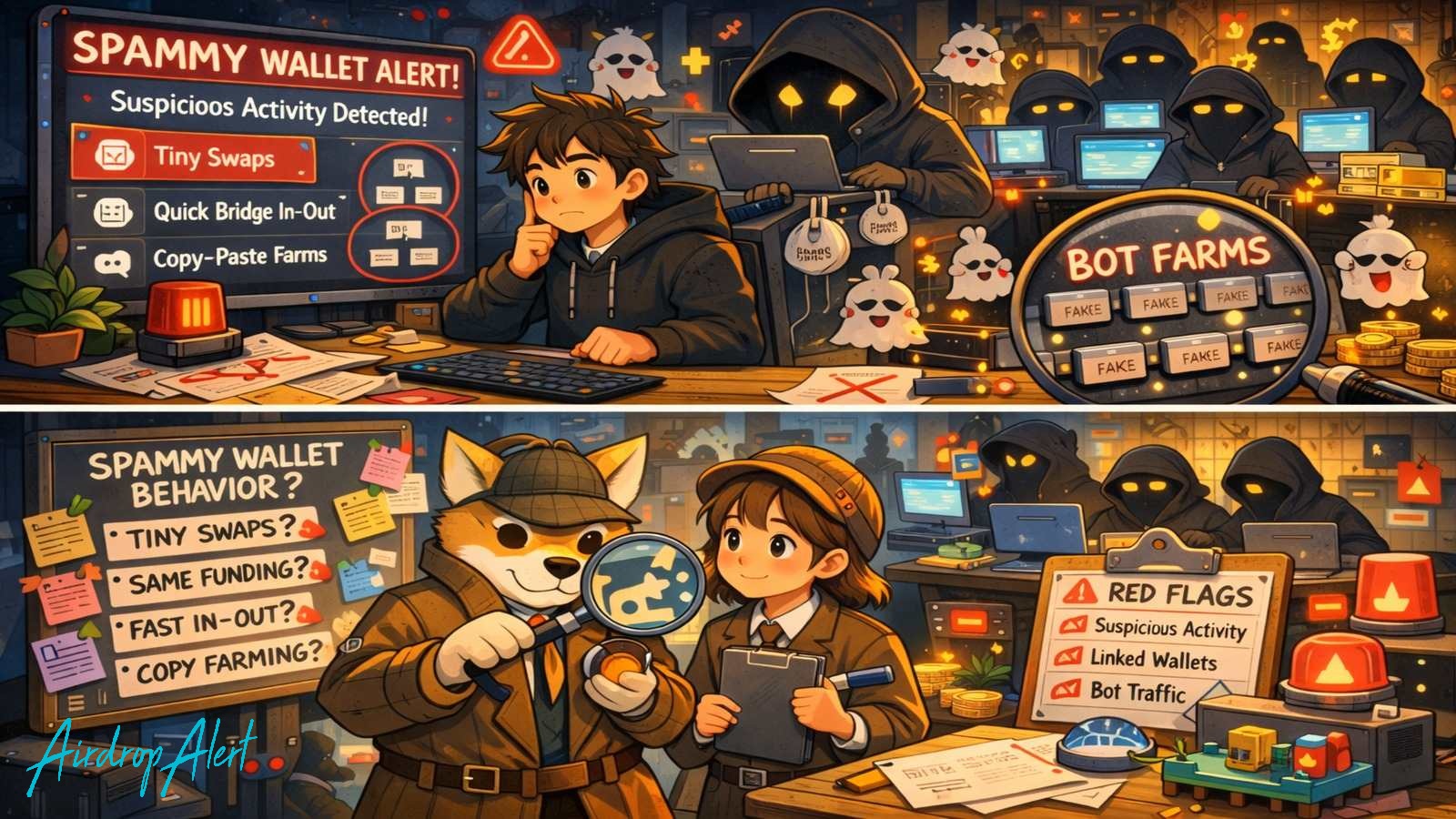
That might mean tiny swaps, rushed bridge activity, or copy-paste patterns across multiple wallets. In some cases, it also means only joining an ecosystem once rumors start, then disappearing again right after.
In short, spammy wallet behavior is activity that does not tell a believable human story.
A real user explores crypto over time.
A sybil farm or weak farming wallet usually looks like it is speed-running a checklist.
The easiest way to think about it
Ask yourself one question:
If a project looked at this wallet without knowing it was mine, would it look like a real crypto user or like someone trying to game the system?
That question alone will save you a lot of mistakes.
Because once you start viewing your wallet like a project would, a lot of spammy wallet behavior becomes obvious very quickly.
Classic signs of spammy wallet behavior
Let’s go through the biggest ones.
1. Tiny back-and-forth swaps
This is one of the most common mistakes.
Some users keep swapping tiny amounts, often under $10, back and forth just to increase transaction count. They think more activity means better odds.
Usually, it does not.
Instead, it makes the wallet look forced. Especially when the same token pairs are used again and again, with no real reason behind the trades.
A real user might swap to enter a position, LP, stake, or try a protocol.
A spammy wallet often swaps for no reason other than creating a number.
That is classic spammy wallet behavior.
2. Bridging to a chain and doing almost nothing
This is another huge one.
Bridge in. Make one swap. Bridge out.
Or worse, bridge in, do nothing, and leave.
That does not look like ecosystem participation. It looks like someone touched the chain just to qualify for something.
If you bridge to a new chain, do more than the minimum. Use a few products. Come back later. Leave some funds there. Give the wallet some depth.
Otherwise, the bridge activity often looks empty and sybil-like.
3. Adding liquidity, then removing it too fast
Liquidity provision can be a great signal.
But only if it looks natural.
If you add funds to a vault or LP and remove them within 24 hours, that can start to look very weak. It tells the project you were likely there for the checkbox, not the ecosystem.
The same goes for vault deposits that last a few hours only.
A better pattern is simple. Leave the funds there for a few days, a few weeks, or longer if it makes sense.
Time matters.
Fast in-and-out behavior is one of the easiest forms of spammy wallet behavior to spot.
4. Doing the exact same actions across multiple wallets
This is one of the easiest ways to expose a farm.
Let’s say you have five wallets.
They get funded around the same time, bridge the same amount, follow the same swap route, use the same protocols, LP into the same pool, and leave at nearly the same moment.
That is not five users.
That is one pattern repeated five times.
Projects may not always explain how they filter this, but linked wallet behavior is one of the most obvious things to watch for. This is also where sybil detection starts becoming very relevant. If your wallets are meant to look separate, then they need separate timing, separate flows, separate balances, and separate paths.
5. Funding all wallets from the same source
A lot of people forget this one.
Even if your activity looks decent, funding multiple wallets from the same source can make them look connected very quickly.
The same problem appears when your own wallets transact between each other. Sending funds back and forth, topping each other up, or rotating assets between them weakens the idea that they are separate identities.
If you want multiple wallets, treat them like separate users.
Keep them separate.
Otherwise, your setup starts looking more like a sybil cluster than a group of real users.
6. Only using reward pages and obvious farm routes
Some wallets never interact with anything except the most obvious reward pages, quest dashboards, and airdrop tracking routes.
That is a bad look.
A healthy wallet should use products, not just reward systems.
That can mean swaps, vaults, staking, governance, NFTs, lending markets, perps, social layers, or other ecosystem tools. The more your behavior looks like actual product usage, the better.
If your wallet only shows up where the reward might be, that becomes obvious over time.
That is another strong example of spammy wallet behavior.
7. Farming only when rumors begin
This is a big one, especially in hot markets.
A protocol gets attention. People start talking about a possible airdrop. Suddenly, thousands of wallets appear and do the same basic actions in a short time frame.
That rarely looks good.
The best wallets are usually built before the rumor cycle starts. Those wallets already have history, repeated activity, and a much more believable profile.
The wallets that suddenly wake up only when the timeline gets excited often look late, opportunistic, and closer to sybil farming behavior than real ecosystem usage.

More subtle spammy wallet behavior people miss
Not all spammy wallet behavior is obvious.
Some of it looks normal on the surface, but becomes weak when you zoom out.
Using the exact same transaction size every time
If every swap is the same amount, every bridge is the same size, and every wallet repeats the same number again and again, that can start to look robotic.
Real users are not perfectly symmetrical.
Variation helps.
Doing too much activity in one day
Some farmers try to “catch up” in one session.
Ten swaps, three bridges, a vault deposit, an NFT mint, and a governance action all in one hour.
That is not always a deal breaker. Still, if the wallet then goes quiet for three weeks, the pattern starts looking unnatural.
Better to spread your activity out over time.
Never leaving funds deployed
If your wallet is always entering and exiting, always moving on, and never leaving capital parked anywhere, that can make it feel disposable.
Real users often leave something behind.
That could be stables on a chain, a vault position, a staking balance, an LP, or even just an ecosystem token held for a while.
Not every airdrop cares about governance.
Still, if a protocol has clear community tools and your wallet never votes, never participates, never stakes, never does anything except financial actions, then the story can feel incomplete.
Depth matters.
What a non-spammy wallet looks like instead
A healthy wallet usually looks slower, broader, and more natural.
A healthy wallet might bridge one week, swap the next, add to a vault later, and then return to that same ecosystem the following month. Along the way, it could vote when possible, keep some assets parked there, and interact with more than one protocol on the chain.
Most importantly, it does not look rushed.
The wallet feels like a person using crypto, not a farmer speed-running a route.
That is the goal.
If you want to avoid spammy wallet behavior, think less about transaction count and more about believable usage.
Important: Learn to to protect yourself in the more dangerous world of crypto.
How to check your own wallets for spam signals
Before farming any new protocol, review your wallet honestly.
Here are a few good questions to ask:
- do I only show up when an airdrop is rumored?
- do I bridge in and leave too quickly?
- do I use the same tiny swap amounts every time?
- do my wallets all follow the same path?
- do I ever leave funds deployed?
- do I come back over time?
- do I use the ecosystem beyond the reward page?
- does this wallet look like a real user?
- does this setup look like something a project could flag as sybil behavior?
If too many answers point in the wrong direction, your strategy probably needs work.
What you should do instead
The fix is usually simple.
Slow down.
You do not need more random actions. You need better behavior.
That means:
- use your wallet over time
- bridge and swap like a normal user
- interact with more than one product
- leave funds deployed for longer
- revisit ecosystems instead of touching them once
- vote when it makes sense
- avoid identical behavior across wallets
- stop chasing pure transaction count
Airdrop farming is no longer about looking active for one weekend.
It is about looking real for months.
That is how you reduce spammy wallet behavior and lower the chance of looking like a sybil farm.
Support Our Work
If you found this helpful, consider signing up on BloFin (Non-KYC) or Bybit using our referral links. Your support keeps this content free and flowing.
Why this matters even more in boring markets
This is the part many people still underestimate.
Boring markets are when good wallets are built.
In slow periods, fewer people care. Fewer rumors are flying around. Less fake activity rushes in. That makes it the perfect time to build clean wallet history.
Then, when the next big cycle comes and major airdrops start paying again, the strongest wallets are often the ones that were already active long before the hype.
That is how past six-figure winners happened.
Not by showing up in the final month.
But by building believable activity for a long time before the market cared.
Final thoughts
Airdrops changed because the market changed.
In the early days, projects mainly wanted reach. They wanted as many wallets as possible. That made sense for that era. Crypto was smaller, and distribution alone was valuable.
Today, that is no longer enough.
Teams have now seen exactly what happens when low criteria gets abused. Bot farms move in fast. Wallet clusters start copying the same routes. Copy-paste farming strategies try to drain rewards without adding any real value. Over time, spammy wallet behavior turns what should be a community reward into a sybil game.
So now the game is different.
Projects are looking harder for quality users. They want people who explore, return, participate, and actually look like future members of the ecosystem.
That is why spotting spammy wallet behavior early matters so much.
If your wallet looks rushed, repetitive, shallow, or fake, fix it now. Do not wait until snapshot rumors start. By then, the strongest wallets are usually already built.
The best airdrop farmers are not just active.
They are believable.
And the sooner you learn what spammy wallet behavior looks like, the better your odds will be when the next big rewards arrive.
If you enjoyed this blog, check out our recent blog with 8 different crypto cards with cashback.
As always, don’t forget to claim your bonus below on OKX. See you next time!