



Cryptocurrencies are considered a high-risk asset class. Investing in them may result in the loss of part or all of your capital. The content on this website is intended solely for informational and educational use and should not be interpreted as financial or investment advice.
Crypto markets have not given traders much comfort this week. Bitcoin is trading at $62,569.01 after falling 2.10% over 24 hours and 1.78% over seven days, while Ethereum is at $1,690.32 after a 2.93% daily drop (holding a 1.07% gain across the week).
CoinMarketCap data shows a broader market still under pressure, with total crypto market cap near $2.16 trillion and down 2.5% over the past day. Bitcoin dominance remains high at 58.19%.
That is the tension in 2026: Bitcoin is the most recognized asset in crypto, but it is not where most on-chain experimentation happens. Ethereum has DeFi, stablecoins, restaking, Layer 2s, and an enormous developer culture, and Solana has speed, retail energy, and consumer-grade applications. Bitcoin has deep liquidity, but there’s not much you can do with it other than hold it.
This is why Bitcoin Hyper (HYPER) is drawing attention during a bearish market, aiming to make Bitcoin usable again for payments, DeFi, staking, and applications without asking users to abandon the asset that brought them into crypto.
HYPER is one of the biggest presales of the year, having raised $32.8 million so far, and currently offers a 36% staking APY. In a weaker market, that kind of raise suggests traders are looking for infrastructure that makes Bitcoin feel alive again.
How Bitcoin Hyper Handles Near-Instant Payments
Bitcoin Hyper is built around the simple idea that Bitcoin should remain the final settlement layer, but it does not need to carry every transaction by itself. The base chain is secure, scarce, and slow by design. HYPER’s Layer 2 exists to do the work that Bitcoin itself was never built to do at modern crypto speeds.
The process begins with a canonical bridge where users deposit BTC to a designated Bitcoin address monitored by Bitcoin Hyper’s bridge system. The bridge verifies block headers and transaction proofs, and once the deposit is confirmed, an equivalent amount of BTC is minted on Bitcoin Hyper’s Layer 2, where it can move with Solana speeds – that’s near-instant finality and sub-cent costs.
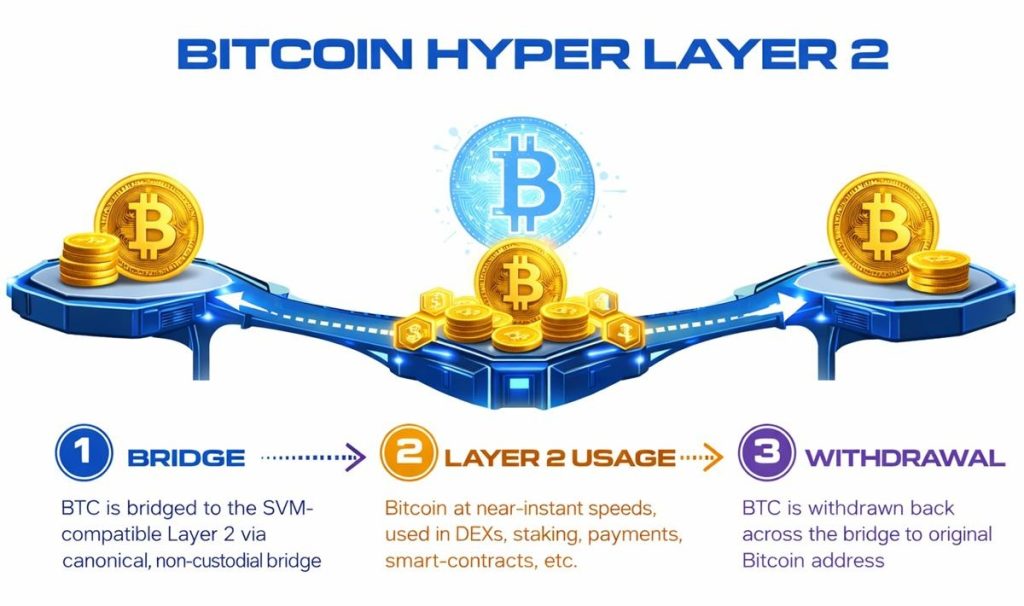
While millions of people trust Bitcoin as an asset, far fewer use it as a daily financial network – 7 transactions per second is fine for a reserve asset but not enough for payments, trading apps, games, tokenized markets, or consumer crypto. Those transactions were moved elsewhere because they had to be.
Bitcoin Hyper’s answer is to deliver a faster execution environment for Bitcoin via the Solana Virtual Machine. SVM architecture is designed for high throughput, and introducing smart contracts enables decentralized exchanges, lending markets, staking tools, wallet applications, and meme coin ecosystems that settle back to Bitcoin rather than live on rival chains.
Periodically, Layer 2 transactions are batched and compressed, with zero-knowledge proofs used to confirm them. The Layer 2 state is then committed back to Bitcoin Layer 1. In plain English, Bitcoin Hyper separates execution from settlement, allowing the fast layer to handle activity. Then Bitcoin does what Bitcoin does best, which is to provide the final anchor.
The HYPER token is used for transactions, staking, and governance.
Why HYPER Could Become the Next Crypto to Explode in 2026
The bullish case for HYPER starts with a market truth that is easy to overlook in bearish weeks: Bitcoin still has the largest audience in crypto. It has the deepest cultural memory, the strongest institutional recognition, and the simplest narrative. Yet most of the creative work in crypto has happened somewhere else.
Over the last 5 years, Ethereum Layer 2s have become major markets because Ethereum is valuable but congested. Solana grew because users wanted speed and near-zero gas fees. Bitcoin Hyper is looking at a bigger prize: the enormous pool of BTC holders who have never had a reason to use Bitcoin on-chain beyond buying, holding, and selling.
Above the buildings, above the noise.
Watching the whole stack come together. 🔥⚡️https://t.co/VNG0P4GuDo pic.twitter.com/tXtatdCKzz
— Bitcoin Hyper (@BTC_Hyper2) June 17, 2026
If Bitcoin Hyper can make BTC feel fast, cheap, and programmable, the addressable market is massive – it is Bitcoin capital being invited into a more active economy, rather than sitting idle. That means BTC-backed DeFi, payments, staking, applications, and token launches that use Bitcoin as their trust layer while avoiding the clunky experience of the base chain.
Bitcoin Hyper’s $32.8 million presale raise shows that demand has already formed before exchange listings. That does not guarantee success, but it does give the project a stronger starting point than most early-stage launches. Liquidity, attention, and community are not afterthoughts in crypto.
There is also an innate pull here, in that Bitcoin began as peer-to-peer electronic cash, before becoming digital gold. That shift made it more valuable, but less used. Bitcoin Hyper is trying to reopen the original question without disrespecting what Bitcoin has become.
What if Bitcoin could keep its role as the hardest settlement layer in crypto, while a faster layer restores its ability to move, trade, and build?
The Bigger Bet Is on Bitcoin Becoming Active Again
The market is bearish now, but when it goes quiet, stronger narratives often separate from the noise. Bitcoin Hyper has found attention because it speaks to a real frustration: Bitcoin may be best, but much of the industry’s activity has moved away from it.
2026 may be the year Bitcoin moves beyond passive holding and back toward active use, all thanks to the unique idea of Bitcoin Hyper.